

Job Search Essentials
How To Match Your Resume To Every Job Description

If you’re like many job seekers, you might have a “one-size-fits-all” resume that you send out for every job opening. However, our career coaches can tell you from experience tailoring your resume to each job description is one of the smartest moves you can make.
It may take a bit more time, but the results are worth it. Let’s go through why a generic resume often falls flat and walk through exactly how to customize your resume for any job step by step.
By the end of it, you’ll know how to tweak your resume like a pro so it passes those pesky ATS scans and wows the human recruiters on the other side.
In This Guide:
Why Tailoring Your Resume Matters
How To Analyse the Job Description and What To Look Out For
7 Steps to Match Your Resume to Any Job Description
Best Techniques for Effective Customization
Start Landing Jobs Right Away
Why Tailoring Your Resume Matters
Tailoring your resume with relevant keywords and achievements can dramatically improve your chances of getting noticed. Think of your resume as a marketing brochure for you.
If you send the same generic brochure to everyone, it won’t resonate with most readers. Employers want to know that you’re a fit for their specific needs. A generic resume that doesn’t speak directly to the job description can come across as unfocused or irrelevant.
In contrast, a tailored resume immediately shows the hiring team that you took the time to understand the role and highlight the exact skills and experiences they’re looking for.
It’s the difference between getting lost in a big pile of applications and catching a recruiter’s eye in seconds.
In today’s job market, customization isn’t just a nice-to-have – it’s often necessary to get past the initial screening. Online job postings attract a large number of applicants (on average, about 250 resumes per opening), and recruiters spend only 6–8 seconds reviewing each resume.
A generic resume is easy for them to skim over or discard. Even more importantly, many companies use Applicant Tracking Systems (ATS) to filter resumes.
These automated systems look for specific keywords and criteria from the job description. In fact, roughly 75% of resumes are rejected by ATS software and never seen by human eyes. Less than 1 in 10 resumes make it to a hiring manager’s desk.
Tailoring your resume with the right keywords and relevant details greatly improves the odds that you’ll make it through the digital gatekeeper.
And once your resume is in front of a person, customization helps it immediately grab the recruiter’s attention.
After all, 63% of recruiters say they prefer resumes that are tailored to the specific job, rather than a generic resume sent everywhere.
How To Analyse the Job Description and What To Look Out For
So how do you figure out what to tailor? It all starts with the job description. Think of the job posting as the answer key – it literally tells you what the employer wants. The trick is learning how to read between the lines. Here’s how to break down a job description effectively:
Read the entire posting carefully, at least twice.
The first read gives you a general idea of the role. On the second read, start highlighting or noting the key requirements – those must-have skills, experiences, and qualifications the employer emphasizes.
Pay attention to sections like “Responsibilities,” “Qualifications,” and “Requirements.” If the description is long, don’t skim – there are often important clues scattered throughout.
Identify the must-haves vs. nice-to-haves.
Job descriptions often list required skills/experience and preferred or bonus skills. Make sure you can identify which are which.
For example, “3+ years of marketing experience” might be a must-have, while “experience with CRM software” might be a nice bonus.
A good rule of thumb: if you see something mentioned multiple times or described as “required/basic qualifications,” it’s critical. If it’s under “preferred qualifications” or mentioned in passing, it’s helpful but not mandatory. Focus your tailoring primarily on the must-haves first.
Recruiters typically will only consider a candidate who meets at least 50% of the job requirements, so aim for roles where you check at least half the boxes and then emphasize those points in your resume.
Pick out the keywords and phrases.
These are specific words that jump out as important – often job titles, technical skills, tools, certifications, or industry-specific jargon.
For instance, if you see phrases like “project management,” “Java programming,” “CRM software,” “customer outreach,” etc., those are likely keywords. Also note any soft skills keywords such as “team player,” “communication skills,” “adaptable,” if they seem important to the role.
Make a list of all these key terms because you’ll want to mirror as many of them as possible in your resume (assuming you truly have those skills or experiences). Remember, ATS software is often scanning for exactly these keywords.
Understand the company’s priorities and culture clues.
Beyond the explicit skills, a job description can hint at the company culture and what type of person succeeds there. Look for adjectives and values: words like “fast-paced,” “innovative,” “collaborative,” “self-starter,” “detail-oriented,” etc. These give insight into the work environment.
For example, if a description repeatedly mentions “fast-paced” and “adaptable,” you can bet they want someone who thrives under pressure and can handle change. Similarly, phrases like “cross-functional team” or “client-facing” tell you the role requires teamwork and communication.
If you sense a company places a high value on something (like creativity, leadership, or cultural fit), you’ll want to reflect that in your resume. In fact, 60% of recruiters say they look for evidence of a candidate’s cultural fit in the resume.
So if the job posting emphasizes certain values or soft skills, be sure to address those subtly in how you describe your work.
For example: mentioning volunteer work to show community involvement if the company values philanthropy, or highlighting teamwork achievements if they mention a “collaborative culture.”
Note the soft skills vs. hard skills.
Hard skills are the technical abilities and knowledge (e.g. coding, budgeting, writing, operating machinery), whereas soft skills are more about personal attributes and interpersonal abilities (e.g. leadership, communication, time management).
Job descriptions often include both. Identify which soft skills are mentioned and think of where you’ve demonstrated those in your experience.
For example, if they want someone who is “detail-oriented,” you might recall a project where your attention to detail caught a mistake that saved the company money – that’s something you could work into your resume.
For hard skills, make sure any that you possess from their list are clearly visible in your resume (preferably in your skills section and in the context of your job experience bullets).
In a nutshell, analyzing the job description is about reading actively. Mark it up, take notes, and really digest what the employer is asking for. Once you have this “cheat sheet” of what matters to them, you’re ready for the next step: tweaking your resume to mirror those needs.
7 Steps to Match Your Resume to Any Job Description
Follow these seven steps to customize your resume for each job application. It might feel like extra work, but even a few small tweaks can make a huge difference in whether you get called for an interview.
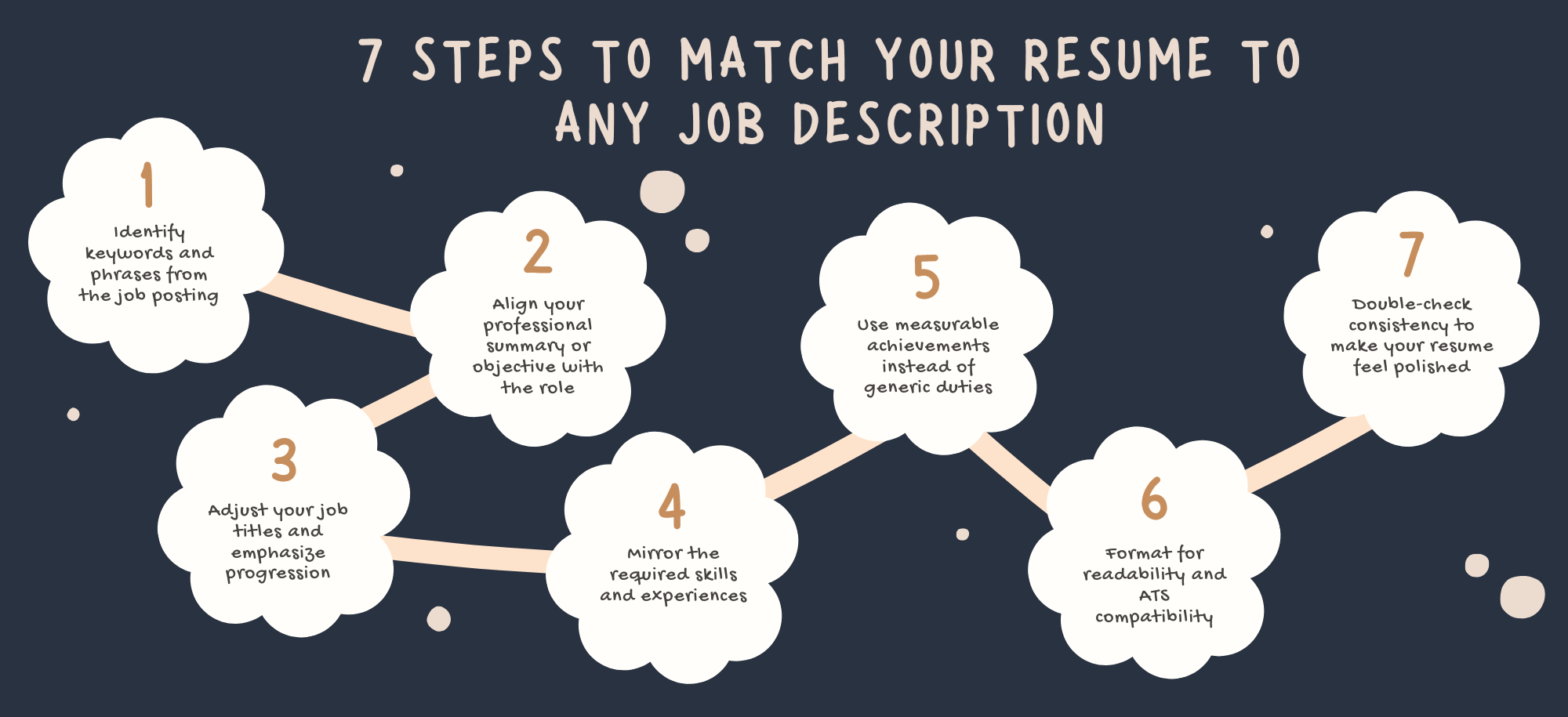
Step 1: Identify keywords and phrases from the job posting.
Start by taking that list of keywords you pulled from the job description and make sure you incorporate them into your resume. The goal is to use the same language the employer uses.
If the job ad says they need someone with experience in “Java and Python programming,” use those exact terms instead of a generic “experienced in several programming languages.”
This isn’t about copying the job description word-for-word (please don’t do that), but rather speaking their language so both the ATS and the human hiring manager see a clear alignment.
Think of it as echoing back the key skills they’re looking for.
Many ATS programs scan for exact matches on keywords the hiring team provided, so if you have those skills, spell them out exactly as the job posting does.
As you insert keywords, make sure it reads naturally. The resume still needs to flow well for the human reader, not just the computer.
Sprinkle the most important keywords throughout your resume in your summary, work experience bullets, and skills section.
Step 2: Align your professional summary or objective with the role.
The top section of your resume is prime real estate to hook the reader immediately. Don’t keep a one-size-fits-all, vague opening. Instead, tailor it to reflect the key qualifications for the job.
For example, if you’re applying to a Marketing Manager position and the description emphasizes leadership and data-driven strategy, your summary might say something like:
“Marketing professional with 6+ years of experience leading cross-functional teams and driving data-backed campaigns that boost engagement. Seeking to apply expertise in SEO, content strategy, and team leadership to help XYZ Company expand its digital reach.”
See how specific that is? In two sentences, you’ve touched on leadership, data-backed campaigns, and relevant skills – likely mirroring what the job ad asked for.
This immediately tells the employer “Yes, this person fits what we need.” The key is to make that first section scream, “I am exactly what you’re looking for, and here’s why.”
Step 3: Adjust your job titles and emphasize progression.
This one can be a bit tricky, but it can make a difference. If your past job titles are unconventional or very company-specific, consider tweaking them to be more in line with the industry standard or the role you’re applying for.
Important: do not mislead or falsely elevate your title – honesty is crucial. But it’s okay to put an equivalent title in parentheses.
For example, say you were officially a “Level II Support Specialist,” but that role was essentially a Project Coordinator position. You might write it on your resume as “Project Coordinator (Level II Support Specialist).”
This way, the ATS, and the recruiter immediately understand your role relative to their opening. Additionally, highlight how you’ve grown in your career.
If the job description values leadership and you’ve progressed from an analyst to a team lead, make sure that progression is clear.
Perhaps under your experience, you can phrase a bullet like “Promoted from Analyst to Senior Analyst within 1 year for outstanding performance,” which shows advancement.
Sometimes even rearranging or renaming headings can help. For example, if you’re switching careers but did a relevant project, you could have a heading called “Relevant Experience” to group it, making it obvious.
The idea is to frame your experience in terms that match the job’s context. It helps the employer see the connection between what you’ve done and what they need.
Step 4: Mirror the required skills and experiences in your bullet points.
Now, what do you add to your work experience section of the resume?
For each role, especially your most recent jobs, tailor the bullet points to emphasize the parts of your experience that overlap with the job you want.
Let’s say the job description says the candidate “will manage a team of 5 sales associates to achieve a 10% quarterly growth in sales.”
If, in a past role, you led a team or achieved growth, make sure a bullet reflects that – e.g., “Led a team of 6 sales associates to exceed quarterly sales targets, achieving 15% growth in Q2 2023.”
This directly addresses their need. Re-order your bullets so that the most relevant ones (which use similar wording to the job post) are listed first under each job.
If there are duties you had that aren’t relevant to the job you’re applying for, you can simplify or even omit those in favor of highlighting the duties that do matter.
Essentially, you want to act like a mirror – showing the employer their own priorities shining back at them from your resume.
When a recruiter sees that your experience section contains many of the same phrases and skills they put in the job ad, it creates an instant impression that “this person fits the role.”
Make sure to include both hard skills (like software, tools, technical proficiencies) and soft skills or domain knowledge that they require, provided you have them.
Step 5: Use measurable achievements instead of generic duties.
One of the best ways to make your resume pop and prove you’re results-oriented is to include numbers and concrete achievements. Employers love to see what results you delivered, not just a list of what you were responsible for.
Go through your bullet points, and wherever possible, add a statistic, percentage, or number to quantify your impact.
If you “improved efficiency,” mention by how much or what that improvement meant (e.g: “streamlined process X, cutting delivery time from 5 days to 3 days”).
These quantified achievements not only make your experience more credible but also help you stand out to both ATS and humans.
In fact, studies have shown that including numbers in your resume can significantly boost your chances of getting an interview. A study found it could increase your chances by 40%!
So, wherever you can, swap out vague statements for specific accomplishments.
It’s okay if you don’t have a number for every single bullet, just aim to incorporate measurable results frequently throughout your resume.
This also shows the employer you understand what outcomes matter.
Step 6: Format for readability and ATS compatibility.
A tailored resume isn’t just about the text – presentation counts too. You want a clean, easy-to-read format that highlights the tailored content we’ve been working on.
First, make sure you use standard section headings like “Professional Summary,” “Work Experience,” “Education,” “Skills,” etc. ATS systems are often programmed to look for common headings.
Next, avoid fancy layouts that might confuse automated scanners. That means no intricate tables, text boxes, or graphics that could choke the ATS parsing your resume. Keep fonts simple and clear.
- Many career experts recommend sticking to a single-column layout (most ATS have a harder time with multi-column formats).
- Use bullet points (plain round or square bullets are fine) to list achievements.
Not only is it ATS-friendly but also human-friendly, as it creates white space and is easier to scan.
For online applications, a straightforward format is best. Remember, an ATS reads text, not visuals.
Step 7: Double-check consistency.
After making all these changes, take a moment to review your resume holistically. Does it still read well and logically from top to bottom?
Check that the tone and format are consistent. For example, if you abbreviate “MBA” in one place, don’t spell out “Master of Business Administration” elsewhere. Consistency makes your resume feel polished.
It’s also a good idea to ensure that the information in your resume matches any application forms or your LinkedIn profile because discrepancies can be confusing.
Best Techniques for Effective Customization
Here are some extra tips from an expert perspective to help you customize effectively.
- Balance customization with honesty
Tailoring is about emphasis, not fiction. Never claim skills or experience you don’t truly have – hiring managers can usually sniff out inconsistencies, and if you land the job under pretenses, it can backfire.
55% of people have lied on their resume at least once, so resist the temptation to join that crowd.
- Use active language and power verbs
Make every word count, especially in those one-line bullet points. Start each bullet with a strong action verb that conveys impact.
Active wording not only sounds more impressive, but it also aligns better with the dynamic qualities employers seek.
- Leverage templates and samples wisely
It’s perfectly okay to start with a resume template or look at samples for inspiration, just make sure you customize the heck out of them.
A resume template or a sample can give you ideas for phrasing, but avoid generic language that sounds like it came off a template. Recruiters can spot a cookie-cutter resume from a mile away.
Start Landing Jobs Right Away
In the end, a tailored resume is all about making it easy for the employer to say, “Yes, let’s talk to this candidate!” So, next time you find a great job posting, take a deep breath and remember these tips!
You’ll be writing a targeted resume that truly matches that job description, and you’ll stand out as the thoughtful, qualified professional you are.
If you need a hand with your resume or want an expert eye to help tailor it just right, check out our resume writing and job placement services to take the stress out of the process and maximize your success.
Get personalised assistance by clicking the link above or fill up the form below for a free CV review.
And for more job-hunting tips and career advice, be sure to explore our other articles. Good luck with your applications and we’re rooting for you every step of the way!
See our other articles:
- Missing a Cover Letter? Check out of many Cover Letter Templates
- See if your resume fits your industry with our 50+ Resume Samples
- Learn how to send out a Job Application Email